
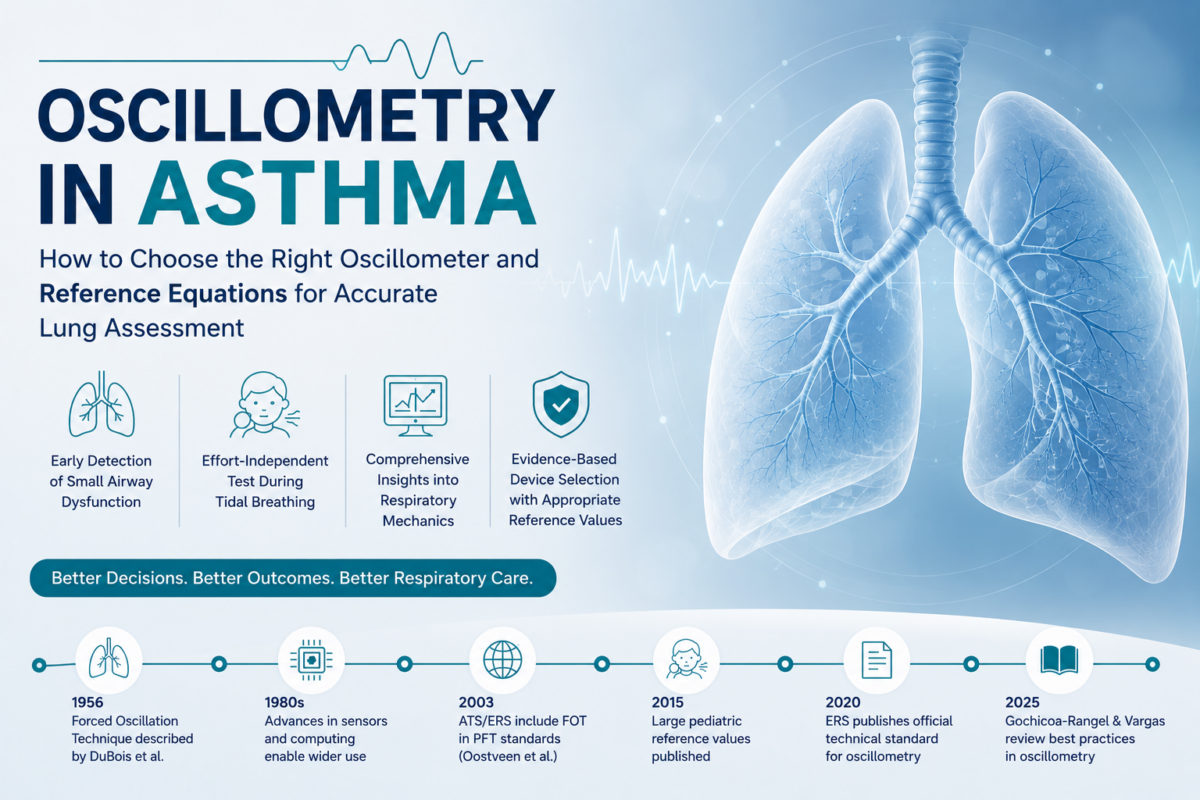
Choosing the Right Lung Oscillometer and Reference Values for Asthma Care
Oscillometry (forced oscillation testing) is a growing tool for assessing lung function in asthma, offering a patient-friendly, tidal-breathing alternative to spirometry. However, a key problem is that different oscillometry machines give different results, and multiple sets of “normal” reference values exist. This can confuse clinicians. A recent review by Gochicoa-Rangel & Vargas (2025) analyses these issues and offers practical guidelines. In brief, they recommend choosing equipment and prediction equations that match your patient population (age, ethnicity) and device characteristics. The payoff is more accurate, comparable results over time.
Problem: Variability in Lung Oscillometry Devices and Norms
Oscillometry (also known as the forced oscillation technique) measures respiratory impedance while a patient breathes normally. It can detect small-airway impairment even when spirometry is normal, making it attractive for early asthma care. In practice, however, oscillometry faces a major hurdle: non-standardized results across devices. As Gochicoa-Rangel & Vargas note, newer portable oscillometers abound, but different models produce non-interchangeable data. It’s like having multiple brands of a meter giving different readings. This variability has so far prevented any single, global set of reference equations for “normal” values to be adopted.
The lack of standardisation means results can be hard to interpret. One recent analysis highlights that clinicians must often have population-specific reference equations to make sense of oscillometry outputs, and even then, device differences still matter. For example, the same patient using two different oscillometers might yield different reactance or resistance values. Without taking device and patient factors into account, readings could be misclassified as normal or abnormal.
Finally, interpreting oscillometry results has its own challenges. Unlike spirometry, which has well-established global standards (e.g. GLI references), oscillometry guidelines are newer. The 2020 technical standard recommends using z-scores (statistical deviations from predicted normal) rather than simple per cent-predicted values. In practice, clinicians may be unfamiliar with oscillometry’s reference norms, leading to inconsistent reporting.
Approach: Surveying Devices and Reference Equations
They performed a comprehensive literature review of oscillometry devices and published reference equations. They compared existing oscillometers (different driving mechanisms like speakers, meshes or pistons) and summarised their frequencies and signals. They also examined the main published normal-value equations in both children and adults, noting which ages and ethnicities each covers.
A useful visual (their Table 1) contrasts devices, showing that models vary in how they generate pulses and the frequencies they measure. (For example, some use a speaker or a mesh to send sound waves down the airway, while others use mechanical pistons. Each device may report slightly different parameters.) The review then cross-references this with published normal-value sets: equations from groups in Mexico, Poland, China, India, and more. They highlight, for instance, that Nowowiejska et al. (Poland) published a widely cited pediatric reference covering ages 3–18, whereas Gochicoa-Rangel et al. (Mexico) provides data on children and adults across a broad range.
One mermaid timeline below summarises key milestones in oscillometry research (for context):
Key Milestones in Oscillometry Research
Results: Recommendations for Lung Oscillometers and Equations
The review’s key findings boil down to these practical guidelines:
- Match device and reference equations. Since devices differ, use prediction equations generated with the same type of device whenever possible. For example, if you use an IOS™ (Impulse Oscillometry System), apply reference values derived from IOS data.
- Cover the full age range. They note that some reference sets end at a certain age, causing abrupt jumps in “predicted” values when a child grows up. It’s best to choose equations that cover all ages of your patients so you can track changes over years without having to switch norms in mid-growth. For instance, the Nowowiejska (Poland) pediatric equation covers ages 3–18, but combining it with an adult set (like Berger et al.) can leave gaps. Instead, Gochicoa-Rangel’s data span from children through adults, which can avoid such discontinuity.
- Respect ethnicity and demographics. Oscillometry normal values depend on ethnicity, height, age and sex – just like spirometry. So if you practice in a largely Asian or Hispanic population, use reference equations developed in similar groups. One example: Wu et al. (2022) reported reference values for Chinese children. Using a mismatched norm can systematically skew results.
- Use z-scores, not raw %pred. The authors emphasise the 2020 ERS standard: always report oscillometry results as z-scores (standard deviations from predicted normal) rather than percent-of-predicted. This avoids confusion when the predicted value is near zero (as is common for reactance).
In short, their ethnic group. They even suggest which published equations fit various scenarios (children only, adults only, or both). For example, they note that Gochicoa-Rangel’s own 2015 Mexican study or Newbury et al. (2019) might be best for certain adult groups, while Nowowiejska (2008) works well for wide pediatric coverage.
Table: Key Claims and Implications
| Claim | Evidence | Implications |
|---|---|---|
| Oscillometry detects small-airway changes earlier than spirometry. | Impulse oscillometry measures small-airway resistance with tidal breathing, revealing dysfunction in mild asthma/COPD. | Early detection of airway impairment; better asthma monitoring. |
| Different oscillometry devices give non-interchangeable results. | The review notes “variability among different devices” that prevents a single standard; a recent study also highlights inter-device inconsistencies. | Clinicians should not compare values across device types; consistency improves follow-up accuracy. |
| Reference norms depend on population and device. | Normal values are influenced by age, height, sex, ethnicity and device type. Published equations (e.g. Poland, Mexico, China) each have different coverage. | Always choose the reference equation derived from a similar population using the same oscillometry method. Mis-match can misclassify patients. |
| Z-scores are more reliable than percent-predicted. | 2020 ERS standards recommend z-scores for oscillometry; fixed %pred can give misleading results near zero. | Reporting z-scores improves consistency and avoids inflated “percent-predicted” values for reactance. |
Meaning: Implications for Asthma Care
Why does all this matter? Accurate, standardised oscillometry can improve asthma diagnosis and management. If clinicians use the wrong reference values or mix devices, a patient’s readings might be wrongly interpreted. Gochicoa-Rangel & Vargas stress that “selecting an appropriate equation is crucial to ensuring diagnostic accuracy”. In practice, this means a child’s oscillometry results should be evaluated against the correct normal curve; otherwise, subtle airway obstruction could be missed or false alarms raised.
On the positive side, when done right, oscillometry adds value. Its sensitivity to small-airway issues (small bronchial tubes) makes it a powerful complement to spirometry for asthma. For example, recent research shows oscillometry-based indices identify poor asthma control even when routine tests seem normal. By following the review’s advice, lung specialists and GPs can trust oscillometry readings to be consistent over time, making it a more reliable tool in clinics.
Also, this work highlights a need for ongoing research: the field should aim for multi-ethnic, device-spanning normal equations. In the meantime, clinicians must stay vigilant: note which equipment they use and pick matching reference data. The payoff is more meaningful oscillometry reports, charts and z-scores that truly reflect each patient’s status relative to peers.