
Why Every Pulmonary Doctor Should Consider Oscillometry in Modern Respiratory Practice
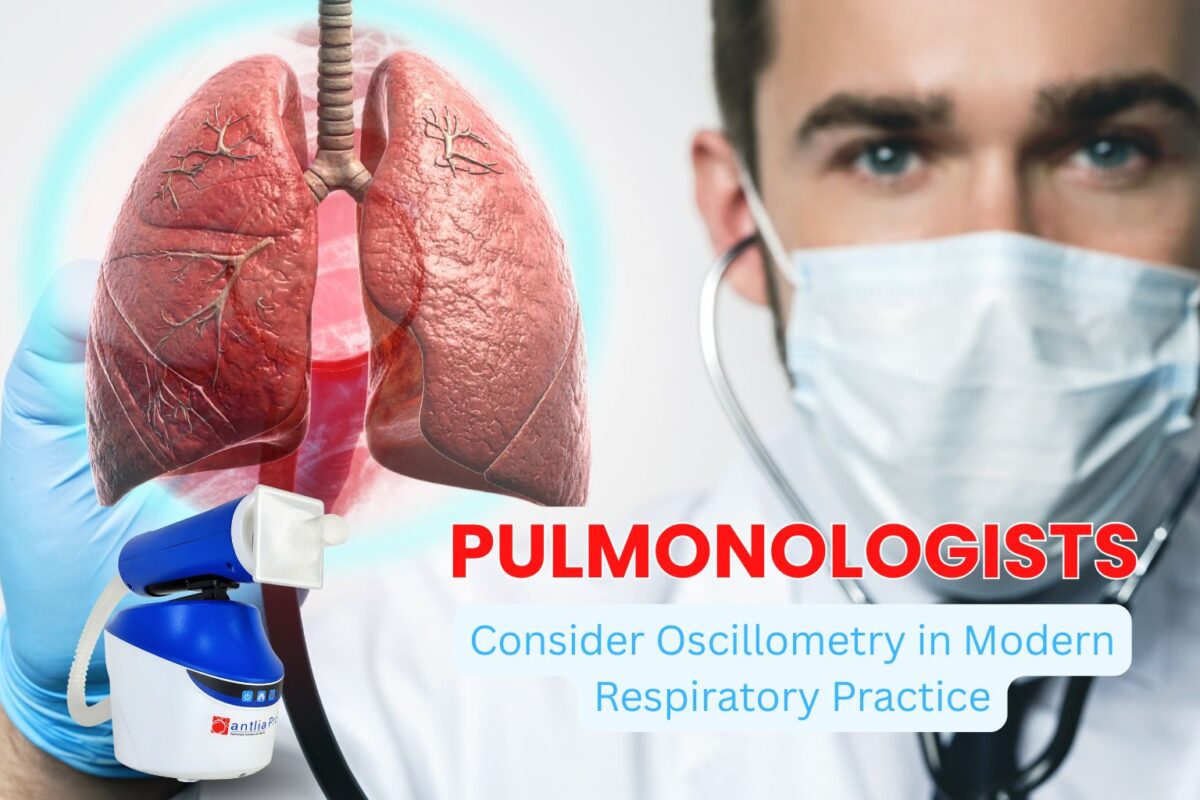
For today’s Pulmonary Doctor, precision, efficiency, and patient comfort are no longer niceties but necessities. As respiratory diseases become increasingly complex and varied, what is needed is a diagnostic tool that goes beyond the capabilities of spirometry.
This is where oscillometry comes in.
Antlia Pro brings a new level of intelligence and patient friendliness to pulmonary function testing. By measuring both central and peripheral airway mechanics without the need for forced breathing efforts, it provides a comprehensive view of lung function, even in patients who have difficulty with traditional testing.
A Better Way to Evaluate Airway Function For Pulmonary Doctor
In contrast to spirometry, which relies heavily on patient effort, oscillometry assesses respiratory resistance and reactance during normal tidal breathing. This offers important information about small airway disease – often before abnormalities are apparent on standard spirometry.
What this means for a Pulmonary Specialist caring for patients with asthma, COPD, or interstitial lung disease is that the Pulmonary Doctor can:
- Detect disease earlier
- Assess disease progression more accurately
- Assess bronchodilator response more sensitively
- Assess patients who cannot perform forced expiratory efforts
All while keeping the test quick, non-invasive, and clinically reliable.
Clinical Applications of Oscillometry in Daily Practice
1. Early Detection of Subtle Airway Changes
Oscillometry has proven to be highly sensitive in both children and adults, frequently detecting airway abnormalities that spirometry fails to reveal. This is particularly important in early asthma or mild COPD, where small airway disease occurs before significant obstruction. Thus, oscillometry is a vital option for pulmonary doctors.
Source : National Library of Medicine
2. Assessing Distal Airway Dysfunction When Spirometry Is Normal
A common clinical dilemma: symptoms persist, but spirometry is normal.
Oscillometry fills this void. Assessing distal airway mechanics, it enables the detection of occult small airway disease, helping to resolve the diagnosis when clinical suspicion is high.
Source : https://pubmed.ncbi.nlm.nih.gov/19811371/
3. Assessing Bronchodilator Response with Increased Accuracy
Oscillometry is useful for assessing reversibility following a short-acting β2-agonist or anticholinergic treatment. Resistance and reactance variations may provide a more detailed analysis of response than the conventional FEV1 test.
This improves treatment options, particularly for patients with ambiguous or mixed patterns.
Source: https://pubmed.ncbi.nlm.nih.gov/16109980/
4. Aiding in the Diagnosis of Restrictive and Complex Pulmonary Diseases
In addition to obstructive disease, oscillometry is useful in the evaluation and management of:
- Bronchopulmonary dysplasia
- Cystic fibrosis
- Interstitial lung disease
- Mixed restrictive-obstructive patterns
It helps in identifying mechanical differences in the respiratory system, thus providing more information in pulmonary function analysis.
Source: https://pubmed.ncbi.nlm.nih.gov/16338598/
5. Particularly Valuable in Difficult Patient Groups
The major benefit for a Pulmonary Doctor is ease of access.
As it only needs quiet breathing, it is very useful for:
- Pediatric patients
- Geriatric patients
- Patients with neuromuscular diseases
- Patients with cognitive impairments
- Patients are unable to provide acceptable spirometry results
This expands reliable lung function testing across diverse populations.
Source: https://pubmed.ncbi.nlm.nih.gov/27578934/
6. Applications in Critical Care and Sleep Medicine
Oscillometry can be used in mechanically ventilated patients and in sleep studies. This expands the use of oscillometry from outpatient clinics to ICUs and sleep labs.
There are very few pulmonary diagnostic methods as versatile as oscillometry.
Source : https://iap-kpj.org/oscillometry-the-future-of-estimating-pulmonary-functions/
7. Safer Testing During Viral Outbreaks
During the influenza and COVID-19 pandemic periods, aerosol production was kept to a minimum.
Since oscillometry does not involve forced expiratory efforts, it is much safer than spirometry in terms of aerosol production. Thus, it is a safer alternative for monitoring asthma and pulmonary diseases during viral outbreaks.
8. High Sensitivity for Small Airway Disease
In conditions such as bronchiolitis obliterans, especially post-infectious forms in children, there are often more significant differences in respiratory reactance (Xrs) than spirometry values.
The sensitivity of oscillometry to small airway disease makes it an invaluable asset in early diagnosis and long-term follow-up. which is more helpful for pulmonary doctors.
Source: https://pubmed.ncbi.nlm.nih.gov/27743492/
Improving Efficiency Without Compromising Accuracy
Antlia Pro allows for quick and easy testing with little instruction required, resulting in fewer repeat tests and an improved flow of the clinic. With the test being simple to conduct, there is less need for staff training, and patient turnaround is increased – all without compromising diagnostic accuracy.
For a Pulmonary Specialist like a Pulmonary Doctor, this means a great deal in terms of both practicality and medical merit.
The Future of Pulmonary Function Testing For Pulmonary Doctors
Oscillometry is meant to complement, not replace, spirometry.
With the growing field of respiratory medicine and the increasing focus on early diagnosis and individualized treatment, the addition of effort-independent lung mechanics evaluation is a definite benefit.