
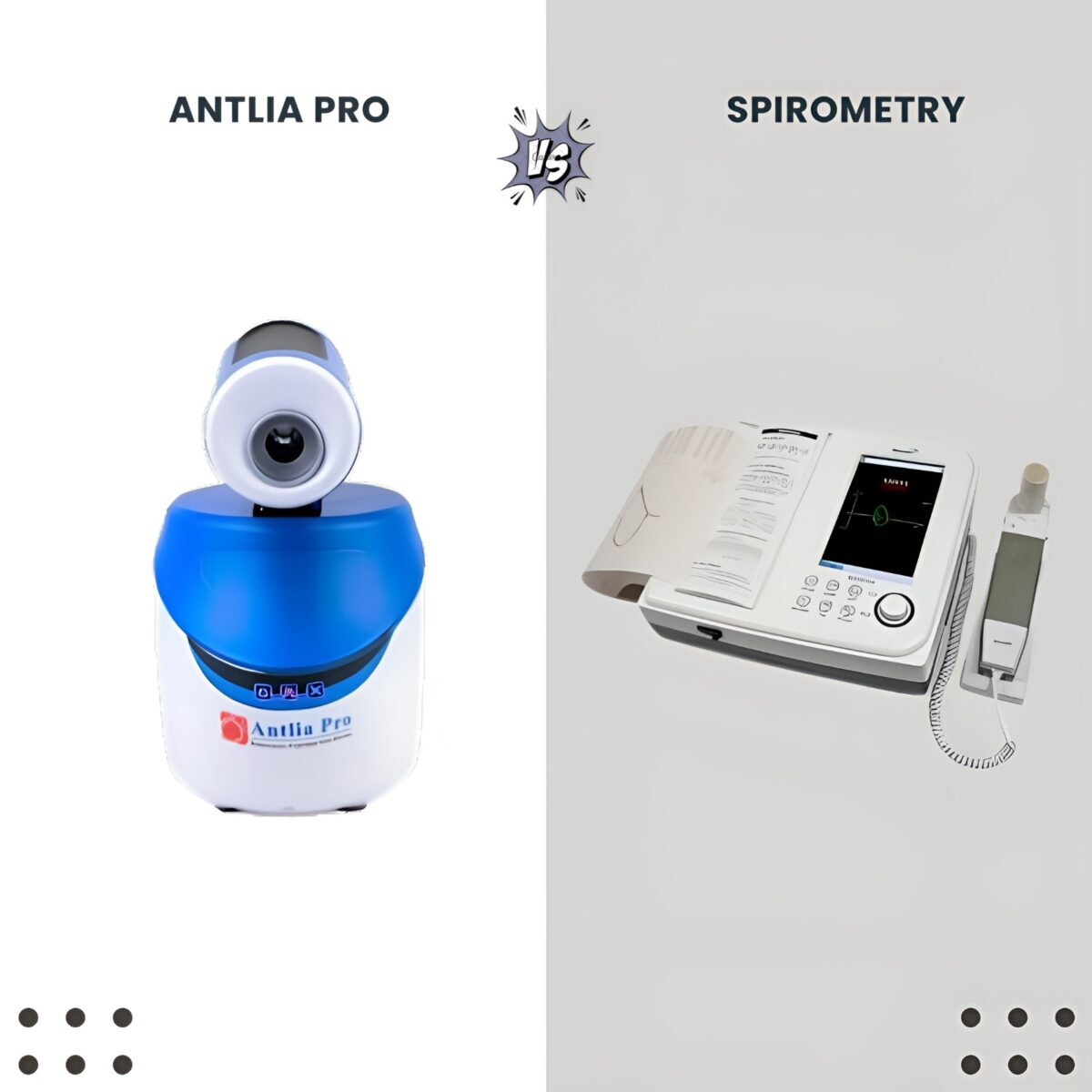
Modern healthcare relies on accurate, patient-friendly respiratory machines to assess lung function, diagnose disease early, and monitor treatment response. While spirometry has long been the standard respiratory machine used in pulmonary function labs, newer technologies such as AI-powered oscillometry are redefining how clinicians evaluate airway mechanics.
This article compares two clinically important respiratory devices—Antlia Pro Oscillometry and Spirometry—and explains how each fits into today’s respiratory diagnostics ecosystem.
What Is a Respiratory Machine?
A respiratory machine is a medical device used to measure lung function, airway resistance, airflow, and breathing mechanics. These machines play a critical role in diagnosing and managing respiratory conditions such as:
Asthma
Interstitial lung disease
Post-COVID respiratory dysfunction
Among the most widely used respiratory machines are spirometers and oscillometry-based pulmonary function analysers like Antlia Pro.
Overview of the Two Respiratory devices

Spirometry: The Traditional Respiratory Device
Spirometry is a pulmonary function test that measures airflow during forced inhalation and exhalation. It provides standardised metrics including FEV₁, FVC, and FEV₁/FVC, making it essential for diagnosing and staging obstructive lung diseases.
Antlia Pro: AI-Powered Oscillometry Respiratory device
Antlia Pro is an advanced respiratory device using oscillometry (Forced Oscillation Technique). It assesses lung mechanics during quiet tidal breathing, applying small pressure oscillations analysed by AI to quantify airway resistance and reactance across different lung regions.
Comparison: Antlia Pro vs Spirometry
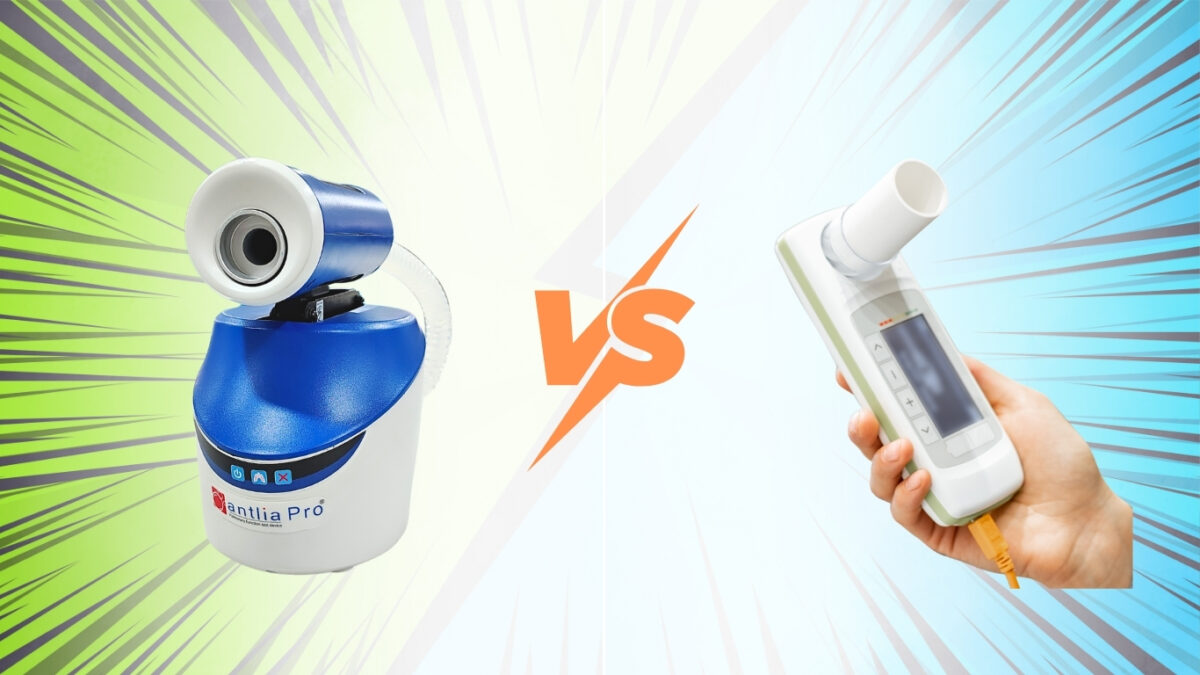
| Parameter | Antlia Pro – AI Oscillometry | Spirometry |
|---|---|---|
| ATS/ERS status | Recognised as a complementary, effort-independent respiratory test | Gold-standard in respiratory test |
| Breathing requirement | Quiet tidal breathing | Forced inspiration & expiration |
| Patient effort | Minimal (passive cooperation) | High (active coordination required) |
| Core measurements | Resistance (Rrs), Reactance (Xrs), AX, Fres | FEV₁, FVC, FEV₁/FVC |
| Small airway sensitivity | High (R5–R19, X5, AX) | Limited |
| Central vs peripheral airways | Frequency-based differentiation | No direct differentiation |
| Feasibility in weak/ill patients | High | Often limited |
| Test time & comfort | Short, well-tolerated | Longer; may induce cough or dyspnoea |
| Clinical role | Detailed airway mechanics & early disease detection | Diagnosis & grading of airflow obstruction |
Why Choice Matters?
Not all respiratory devices detect disease at the same stage. Small airway dysfunction often occurs before spirometry abnormalities appear. A spirometry respiratory machine may report normal values even when early disease is present.
Antlia Pro’s oscillometry-based respiratory machine detects subtle changes in:
Peripheral airway resistance
Lung reactance
Frequency-dependent airflow limitation
This allows for earlier diagnosis, better phenotyping, and more precise monitoring.
Patient-Friendly!

Spirometry respiratory test requires strong patient cooperation, which can be challenging for:
Elderly patients
Children
Critically ill individuals
Patients with neuromuscular weakness
Antlia Pro’s effort-independent respiratory test design improves test success rates and patient comfort, making it suitable for a wider patient population.
Are Oscillometry Replacing Spirometry?
No. The future of pulmonary diagnostics is complementary.
Spirometry confirms and grades airflow obstruction
Oscillometry explains airway mechanics and detects early disease
Together, they provide a complete respiratory assessment that supports precision medicine and better clinical outcomes.
The Future of Clinical Practice.
With increasing recognition by international respiratory societies, oscillometry-based respiratory machines are becoming an essential addition to pulmonary function labs. Antlia Pro, powered by AI analytics, represents the next generation —combining accuracy, simplicity, and patient comfort.
Conclusion
Choosing the right respiratory machine is critical for accurate diagnosis, early detection, and effective disease management. By integrating Antlia Pro Oscillometry with traditional spirometry respiratory machines, healthcare providers gain deeper insights into lung function and deliver better patient-centered care.