
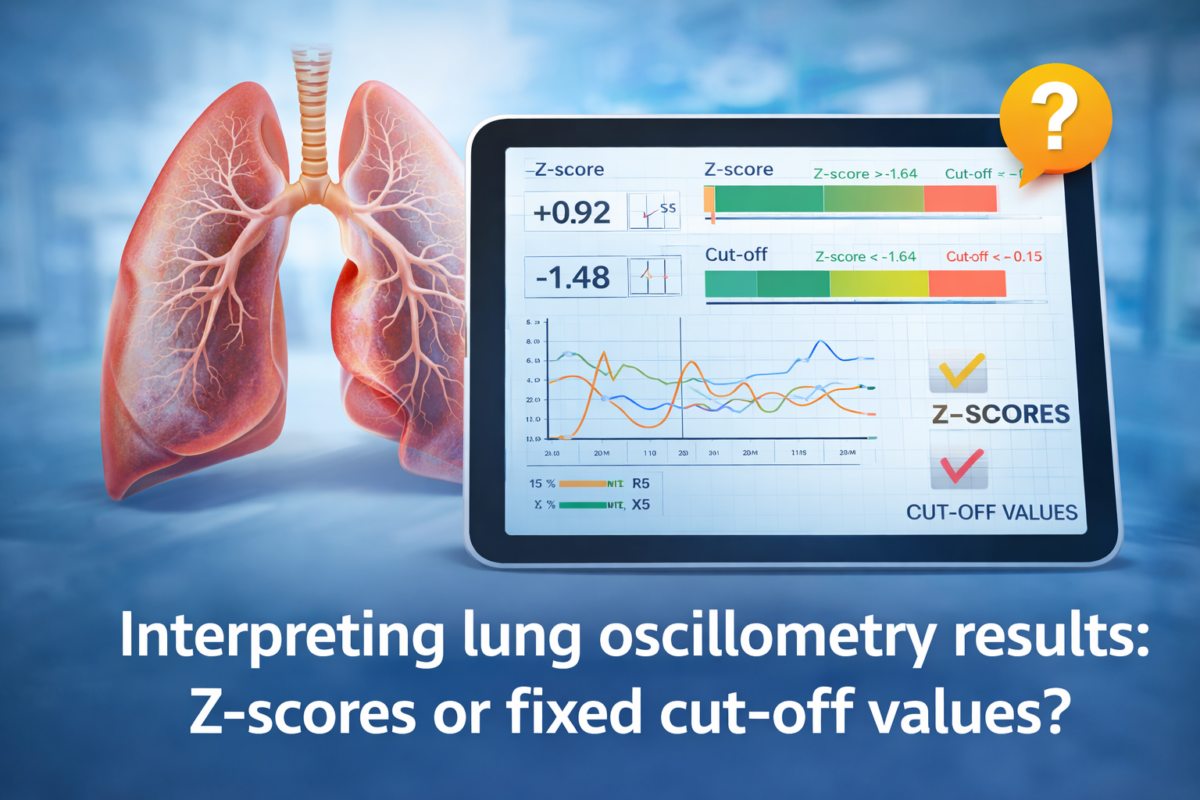
Lung oscillometry, based on the forced oscillation technique, is increasingly used to assess respiratory mechanics in patients who find spirometry difficult. However, how these results should be interpreted remains an important clinical question.
While Z-scores are widely used in spirometry, lung oscillometry parameters do not follow normal population distributions and show weak dependence on age and body size. This limits the reliability of Z-scores for lung oscillometry interpretation. Recent evidence suggests that fixed cut-off values in oscillometry may provide clearer and more practical discrimination between healthy adults and those with obstructive airway disease.
Using fixed thresholds simplifies clinical interpretation and aligns well with real-world lung mechanics, similar to how absolute values are used for blood pressure or blood glucose. Research has shown that oscillometry measurements obtained using the Antlia Pro FOT device demonstrate meaningful sensitivity and specificity when interpreted with fixed cut-off values rather than Z-scores.
As lung oscillometry adoption grows, fixed cut-off–based interpretation may offer a more intuitive and clinically useful approach for routine practice.
Original Research Source
Salvi S, Ghorpade D, Vanjare N, et al. Interpreting lung oscillometry results: Z-scores or fixed cut-off values? ERJ Open Research. 2023;9:00656-2022.
https://doi.org/10.1183/23120541.00656-2022